

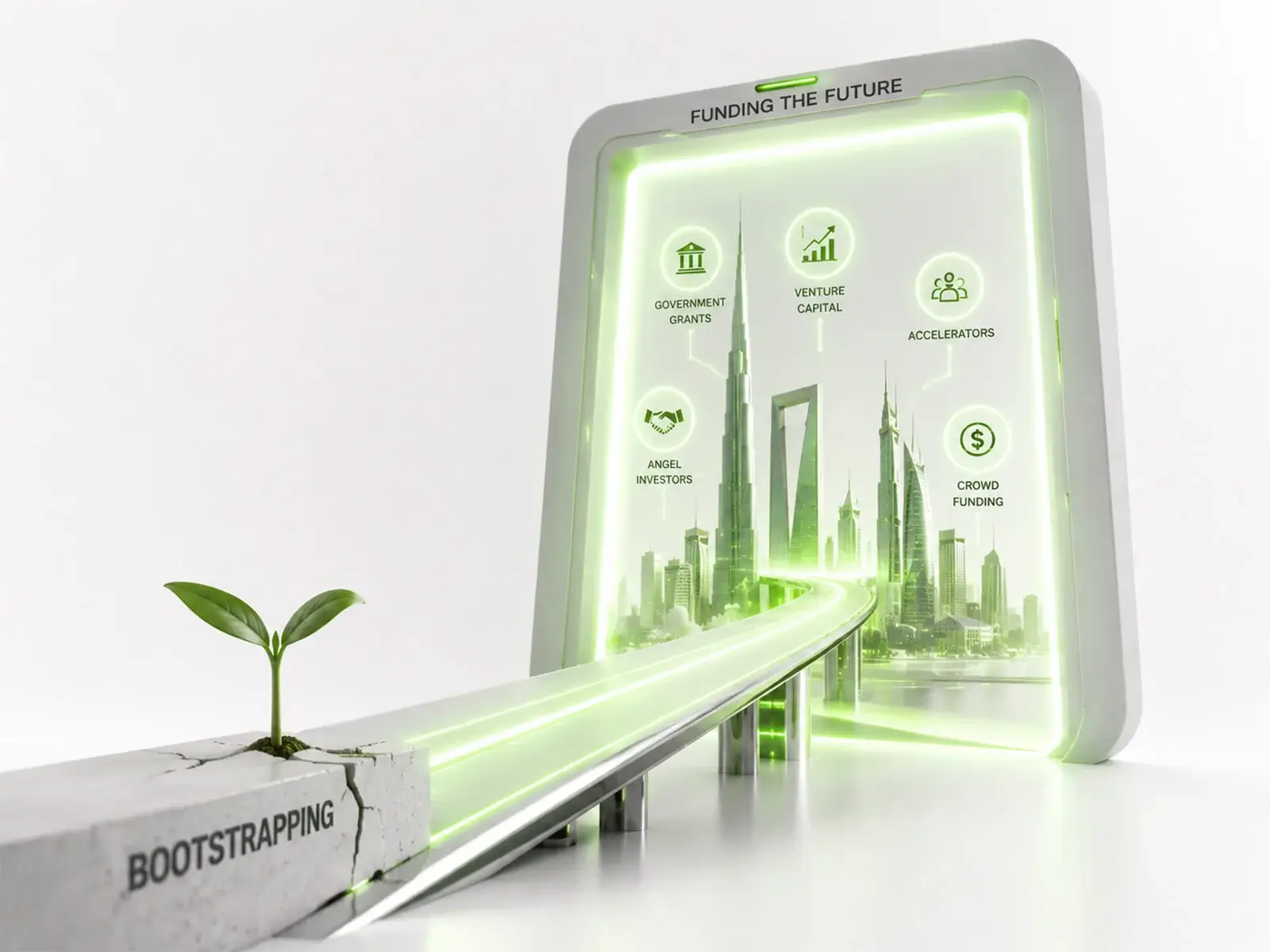
Executive Summary
- The Core Reality: Relying solely on personal savings limits your growth and exposes you to severe financial risk. To scale across the Middle East and North Africa (MENA), founders must tap into the billions of dollars actively flowing through regional VCs, angel networks, and government funds.
- The MENA Impact: Despite record-breaking capital available in hubs like Riyadh and Dubai, over 80% of startups fail to secure funding because they fail Technical Due Diligence. Investors do not fund ideas; they fund scalable digital architectures and premium brand entities.
- The Swira Solution: Swira Design engineers investable digital assets. We bridge the gap between your business model and your pitch deck by building robust, cloud-native Minimum Viable Products (MVPs) and premium corporate identities that prove to investors your business is ready to scale.
Introduction: The Golden Age of MENA Funding
Starting a tech startup or scaling a legacy B2B company in the GCC and Egypt is an exciting endeavor, but it comes with a massive hurdle: capital acquisition.
Historically, regional founders relied heavily on bootstrapping, draining personal savings, or borrowing from family. Today, the financial landscape has fundamentally shifted. Driven by massive economic diversification initiatives like Saudi Vision 2030 and the UAE’s digital-first mandates, institutional capital is aggressively looking for high-growth companies.
However, securing this capital requires more than a good pitch deck. You must present a scalable, digitally mature business. Here are the most powerful funding avenues in the MENA region, and what you need digitally to secure them.
1. Venture Capital (VC) and Institutional Funds
Venture capital firms in Riyadh, Abu Dhabi, and Cairo pool money from large institutions to invest in startups with disruptive, high-growth potential.
- The Target: Tech startups, SaaS platforms, and fintech companies aiming for rapid regional expansion and eventual acquisition.
- The Requirement: VCs look for strong unit economics and technological scalability.
- The Swira Approach: VCs conduct rigorous Technical Due Diligence. If your app is built on cheap, unscalable code, VCs will reject you. Swira Design builds enterprise-grade, cloud-native digital platforms that pass strict technical audits, proving your product can handle millions of users without crashing.
2. MENA Angel Investor Networks
Angel investors are affluent individuals (often retired executives or successful local founders) who invest their personal capital. Regional networks like Oqal (KSA) or Alexandria Angels (Egypt) provide not just seed capital, but invaluable “Wasta” (industry connections) and mentorship.
- The Target: Early-stage startups that have outgrown “friends and family” funding but are too early for Series A VC rounds.
- The Swira Approach: Angels invest in the founding team’s vision and execution. We apply our Design-Driven Engineering philosophy to build high-fidelity interactive prototypes and initial MVPs. We make your product look and feel like a billion-dollar global brand, making it incredibly easy for angels to visualize your potential.
3. Government Grants & Sovereign Subsidies
Governments across the MENA region offer massive financial assistance to encourage tech development, job creation, and economic diversification (e.g., Monsha’at in Saudi Arabia or ITIDA in Egypt).
- The Target: Deep-tech, green energy, e-commerce, and logistics startups that align with national economic visions.
- The Requirement: Grants are “free money,” but the application processes are highly bureaucratic and require proof of operational legitimacy.
- The Swira Approach: To win government grants, you must project total corporate compliance. We architect highly professional, AI-optimized corporate websites (complete with secure data infrastructures) that immediately establish your brand as a legitimate, trustworthy entity in the eyes of government auditors.
4. Regulated Equity Crowdfunding & P2P Lending
The MENA region has seen a massive surge in regulated fintech platforms (like Manafa or Scopeer in KSA) that allow you to raise capital from the public, either by selling small equity stakes or borrowing via Peer-to-Peer (P2P) Islamic finance models.
- The Target: Consumer-facing apps, F&B concepts, and retail startups looking to validate market demand while raising funds.
- The Swira Approach: A crowdfunding campaign is essentially a high-stakes digital marketing funnel. We engineer high-converting landing pages, integrate secure payment APIs, and design compelling visual assets that turn casual website visitors into active financial backers.
5. Business Incubators and Accelerators
Programs like Sanabil 500, Flat6Labs, and Hub71 provide a combination of seed funding, workspace, and intense mentorship in exchange for a small equity stake (typically 7-10%).
- The Target: Pre-seed founders needing structural guidance and rapid market entry.
- The Swira Approach: Accelerators only accept founders who can execute. We act as your outsourced CTO and design team, taking your raw concept and engineering a market-ready product within the strict 3-month accelerator timeline, ensuring you are ready for Demo Day.
Is Your Startup Ready for Due Diligence?
Investors in the Middle East have the capital, but they will not fund businesses with weak digital foundations, poor branding, or unscalable code. 👉 Contact the technical strategy team at Swira Design today to audit your MVP and ensure your digital architecture is ready to secure your next funding round.
FAQ: Startup Funding in the MENA Region
What do MENA Venture Capitalists look for during Technical Due Diligence? Before writing a check, VC firms audit a startup’s software architecture. They look for scalable, cloud-native infrastructure, clean codebases (preventing technical debt), secure API integrations, and robust data privacy compliance. Startups with poorly engineered MVPs are frequently rejected.
Can a strong digital brand identity impact my startup’s valuation? Yes. In the highly competitive MENA startup ecosystem, perceived value directly influences financial valuation. A startup with a premium, enterprise-grade brand identity and a flawless User Experience (UX) commands higher trust from angel investors and VCs, often resulting in better funding terms and higher seed valuations.
What is the difference between an Incubator and an Accelerator in the Middle East? Incubators generally help nurture businesses in their very early infancy (idea stage), providing workspace and foundational mentorship without strict timelines. Accelerators (like Flat6Labs or Sanabil 500) are fast-paced, highly competitive programs that provide seed capital and intense scaling strategies over a set 3-to-4 month period, culminating in a pitch to investors.