

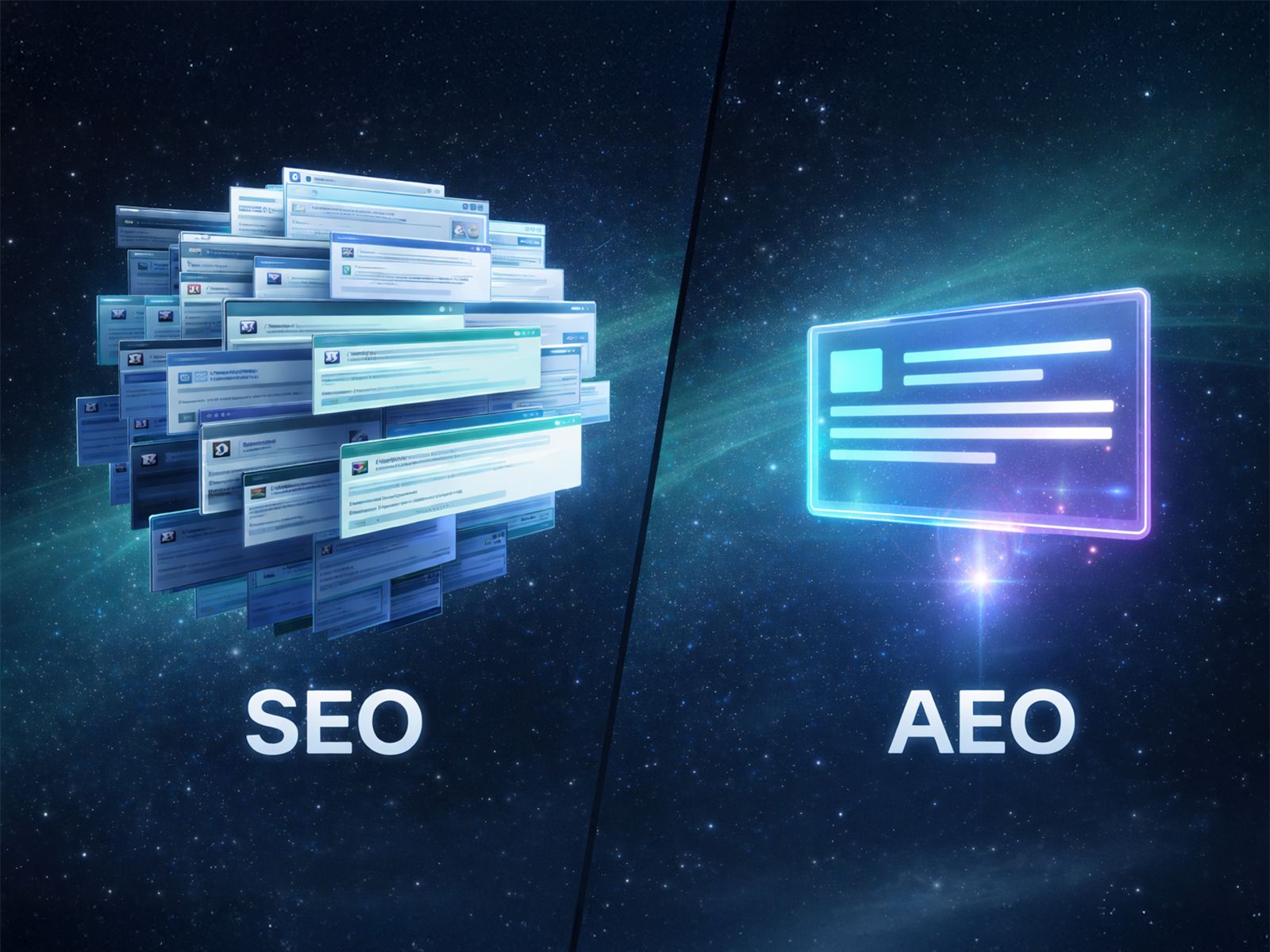
Executive Summary
- The Core Difference
Traditional SEO (Search Engine Optimization) focuses on ranking webpages to generate clicks. AEO (Answer Engine Optimization) structures content so AI models (like ChatGPT Search and Gemini) extract your data to provide instant, “Zero-Click” answers.
- The 2026 Reality
With over 70% of B2B queries in the MENA region now being answered directly via AI Overviews, optimizing solely for traditional search engine clicks means you are losing massive market share.
- The Swira Solution
We engineer websites for both humans and machines. By embedding advanced JSON-LD schemas, LLM-readable architectures, and targeted Q&A formats into premium designs, we ensure your brand becomes the “Ground Truth” for AI search engines.
Introduction: The Evolution of Search
For the past decade, businesses in Egypt, Saudi Arabia, and the UAE relied on a simple formula: rank high on Google, get clicks, and convert leads. But in 2026, search behavior has fundamentally changed. Users no longer want to scroll through 10 blue links; they want immediate, AI-generated answers.
This shift has created a massive divide in digital marketing: SEO vs. AEO. Understanding the difference and implementing both is the only way to safeguard your corporate visibility.
What is SEO (Search Engine Optimization) in 2026?
SEO is the traditional, foundational practice of optimizing your website’s architecture, authority, and content to rank higher on search engine results pages (SERPs).
- The Goal
Drive human traffic directly to your landing pages.
- The Focus
It relies heavily on mapping user intent, building high-authority backlinks, passing Google’s Core Web Vitals (speed and stability), and creating long-form, comprehensive content.
- The Limitation
SEO assumes the user will click your link to find the answer. Today, that is no longer a guarantee.
What is AEO (Answer Engine Optimization)?
AEO is the next evolution of digital visibility. It focuses entirely on structuring your data so that Answer Engines, Voice Assistants, and Large Language Models (LLMs) can easily read, extract, and cite your content as the definitive answer.
- The Goal
Become the cited source in AI-generated summaries and “Zero-Click” answer boxes.
- The Focus
AEO requires precise, structured formats. It relies on direct Question-and-Answer (Q&A) blocks, bulleted lists, data tables, and heavy use of advanced microdata (Schema Markup) so AI bots can parse the information without “reading” the whole page.
The Breakdown: SEO vs. AEO
| Metric | Traditional SEO | Answer Engine Optimization (AEO) |
| Primary Target | Traditional Search Algorithms | AI Models, LLMs, Voice Assistants |
| End Goal | Generating page clicks & traffic | Being cited as the direct answer |
| Content Format | Long-form articles, pillar pages | Bite-sized Q&A, lists, and clear data tables |
| Technical Focus | Core Web Vitals, Backlinks, Keywords | FAQPage Schema, LLMs.txt, Entity SEO |
Why MENA Businesses Must Combine Both
If you only do SEO, you will miss out on the growing segment of CEOs and decision-makers using AI to research software partners and B2B services. If you only do AEO, you will lack the domain authority required for AI engines to trust your answers in the first place.
The Swira Approach (AI-Ready Architecture)
At Swira Design, we do not view design and SEO as separate services. Through our Design-Driven Engineering philosophy, we build platforms that excel at both. While our UI/UX team crafts an immersive, high-converting visual experience for human users (SEO), our engineering team actively embeds technical schemas and localized data structures into the code (AEO). The result is a premium digital asset that looks incredible to your clients and reads perfectly to AI bots.
Stop Losing Traffic to AI
If ChatGPT and Gemini are citing your competitors while your website is nowhere to be found, your digital architecture is outdated.
👉 Contact Swira Design today to request a technical SEO & AEO audit, and let us future-proof your digital presence for the AI era.
FAQ: SEO and AEO Strategies
What is the main difference between SEO and AEO?
The main difference is their end goal: SEO is designed to rank webpages to drive user clicks and traffic, whereas AEO (Answer Engine Optimization) is designed to structure content so that AI systems and voice assistants can extract direct, immediate answers without requiring the user to click a link.
Does AEO replace traditional SEO?
No, AEO does not replace SEO; it builds upon it. AI models and Answer Engines only extract information from websites they deem authoritative. You still need strong SEO (backlinks, fast load times, and domain authority) to build the trust required for your AEO content to be selected.
How can I optimize my corporate website for AI search engines?
To optimize for AI search engines, you must implement strict AEO technical standards. This includes formatting content into direct Q&A blocks, using comprehensive JSON-LD structured data (such as FAQ and Organization schema), and providing high-density, factual data that AI models prefer to scrape.