

Executive Summary
- The Core Shift
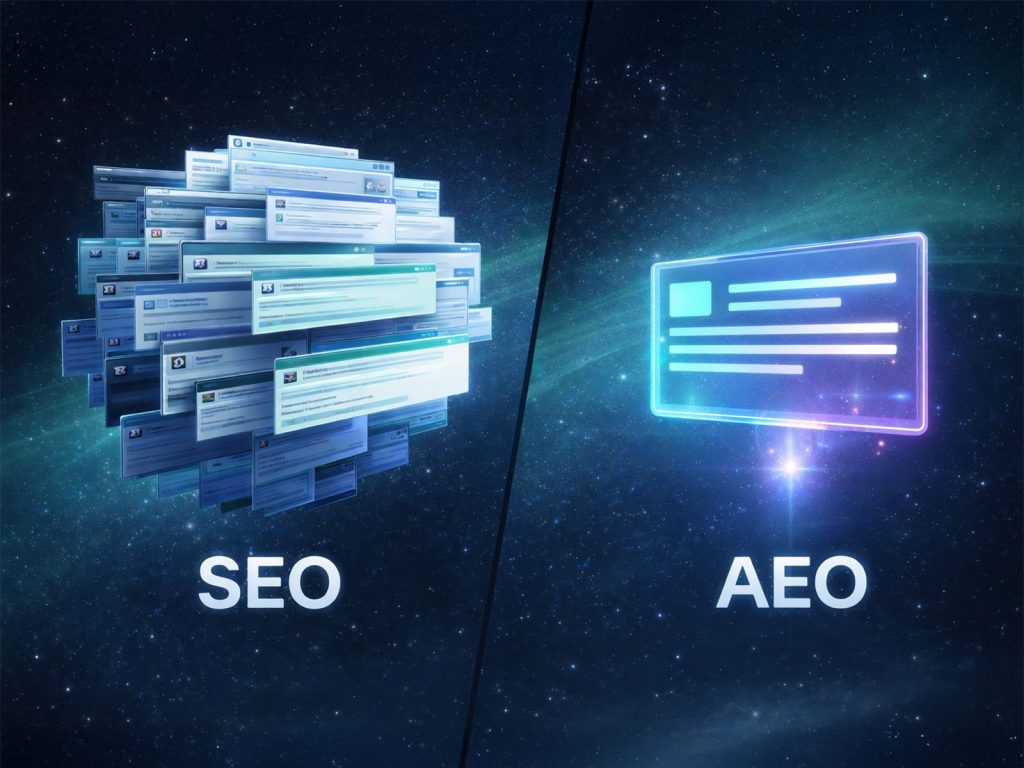
Traditional SEO fights for link clicks. AEO formats data for quick answers. GEO (Generative Engine Optimization) is the highly technical process of ensuring your brand is trusted, synthesized, and cited as a primary source by AI models like ChatGPT Search, Perplexity, and Google’s AI Overviews.
- The MENA Impact
High-ticket B2B decision-makers in Saudi Arabia, the UAE, and Egypt are bypassing traditional search engines, using AI to generate comprehensive vendor shortlists and market reports. If your corporate website lacks “Information Gain” and Entity Trust, AI models will erase you from the narrative.
- The Swira Solution
Swira Design utilizes “Entity-Based Optimization.” We engineer corporate digital assets using advanced semantic HTML, /llms.txt architecture, and proprietary data structuring, forcing Large Language Models (LLMs) to recognize your business as the definitive “Ground Truth” in your industry.
Introduction: The Generative AI Revolution in the Middle East
The digital landscape across the MENA region is undergoing a violent shift. From tech startups in Cairo to enterprise holding companies in Riyadh, the way business leaders discover information has fundamentally changed. They no longer type fragmented keywords into Google; they prompt AI engines to generate comprehensive, multi-layered answers.
When a GCC executive asks an AI, “Compare the top digital transformation agencies in Saudi Arabia,” the AI does not just return a list of links. It reads, analyzes, and synthesizes data from across the web to write a custom report. Generative Engine Optimization (GEO) is the science of making sure your brand is the one the AI trusts enough to cite in that report.
1. SEO vs. AEO vs. GEO: Understanding the Difference
To dominate the modern search landscape, MENA businesses must understand the evolution of search optimization:
- SEO (Search Engine Optimization)
Optimizing algorithms to rank a webpage highly so humans will click it.
- AEO (Answer Engine Optimization)
Structuring specific Q&A blocks so voice assistants and search engines can extract a direct, short answer.
- GEO (Generative Engine Optimization)
Optimizing for Large Language Models (LLMs). It involves feeding the AI unique statistics, expert opinions, and deep entity-based data. Hence, the AI weaves your brand into its dynamically generated paragraphs and cites you as an authoritative reference.
2. Why GEO is the Ultimate B2B Weapon in MENA
AI engines are trained to avoid hallucination by relying on high-authority “Entities” (verified businesses and experts).
- The Problem
Most corporate websites in the Middle East rely on generic, copied marketing text. AI models penalize generic content. If your website says the same thing as 100 other agencies in Dubai, the AI has no reason to cite you.
- The Solution (Information Gain)
AI algorithms actively seek “Information Gain”, net-new information that cannot be found elsewhere. This includes proprietary local MENA data, original case studies, deep technical architecture, and expert quotes. GEO is the process of injecting this high-value data into your digital presence.
3. The Swira Blueprint: How We Execute GEO
To optimize your corporate platform for generative search, Swira Design implements a strict, multi-layered GEO technical architecture:
- Entity Establishment (E-E-A-T)
AI models must know who you are. We interlink your website with trusted global databases (Crunchbase, Clutch, LinkedIn) and deploy robust Organization and Person JSON-LD schemas to build an unbreakable Knowledge Graph for your brand.
- Deploying the LLMs.txt Standard
We build an /llms.txt file directly into your website’s root domain. This is a 2026 standard markdown file designed specifically for AI crawlers (like OpenAI’s GPTBot) to instantly read and ingest your core business capabilities without getting distracted by visual design code.
- Authoritative Content Structuring
We replace vague marketing fluff with highly structured, data-rich technical content. We use semantic HTML5 elements to clearly define concepts, ensuring AI models evaluate the content as a reliable, academic-grade source.
Is Your Brand Invisible to AI?
Generative AI is rewriting the rules of corporate visibility. If your digital strategy relies on tactics from 2023, you are already losing enterprise leads to AI-optimized competitors. 👉 Contact the digital strategy team at Swira Design today to run a comprehensive GEO and Entity Audit, and secure your place in the AI-generated future.
FAQ: Generative Engine Optimization (GEO)
What is Generative Engine Optimization (GEO)?
GEO is the practice of optimizing website content, technical architecture, and brand entity signals so that Generative AI search engines (like Perplexity AI, ChatGPT Search, and Google AI Overviews) synthesize your data and cite your business as an authoritative source in their generated responses.
How is GEO different from traditional SEO?
Traditional SEO focuses on keyword density and backlinks to win clicks from search engine results pages. GEO focuses on “Information Gain,” semantic structuring, and Entity Trust to ensure that Large Language Models (LLMs) use your proprietary data to actually generate the answers they provide to users.
Why do MENA businesses need an LLMs.txt file for GEO?
An /llms.txt file is a plain-text markdown file placed in a website’s root directory. It provides AI crawlers with a stripped-down, highly concentrated summary of a company’s services, technical capabilities, and brand facts, allowing AI engines to ingest and understand the business instantly without parsing complex website code.